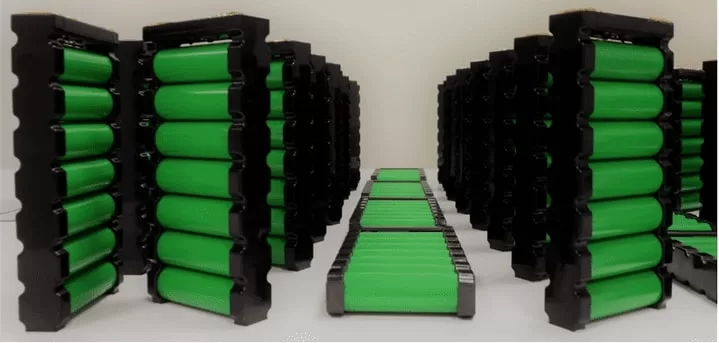


A Battery Management System (BMS) provides several critical functions for drone and UAV battery systems, including cell balancing, battery state monitoring, safety protection, and reliable State of Charge (SoC) estimation. For professional and mission-critical drone applications, these capabilities can significantly improve battery usability, operational safety, and logistics.
Why Do Drones Need a Battery Management System (BMS)?
Insights •
October 12, 2026
Share article

Back to all
 Contact us
1. Eliminating the Need for External Cell-Balancing Chargers
Today, many drone operators rely on battery chargers manufactured in China, particularly chargers with integrated cell-balancing functionality. There is a limited availability of European manufacturers offering chargers specifically designed for advanced drone battery packs.
By integrating a BMS directly into the battery pack, cell balancing can be performed within the battery itself. This means that the battery no longer necessarily depends on an external balance charger to maintain cell voltage consistency.
As a result, the BMS can help reduce dependence on specialized external charging equipment and simplify the charging infrastructure for drone operators.
2. Real-Time Battery Condition Monitoring
Imagine arriving at a field location for a mission, unpacking the drone, and having no reliable information about the actual condition of the battery.
Without a BMS, it can be difficult to determine:
- the remaining battery capacity,
- the current State of Charge (SoC),
- cell voltage consistency,
- battery health and operating condition,
- whether the battery is safe and ready for deployment.
A BMS provides battery status information that allows the operator to assess the battery before take-off. This is particularly important for professional UAV operations, where battery reliability directly affects mission success.
3. Accurate State of Charge Information During Flight
During flight, the drone typically monitors battery voltage. However, pack voltage alone does not provide an accurate representation of the remaining usable energy.
A BMS can provide additional battery parameters, particularly State of Charge (SoC), which estimates the remaining available capacity of the battery.
For example, if a drone has to fly to a target location and return to its launch point, knowing the actual SoC is critical for mission planning and safe return. The BMS can continuously provide battery information to the flight controller, allowing the system to make better decisions based on the remaining energy rather than relying only on instantaneous voltage.
For long-range or mission-critical UAV applications, accurate SoC estimation is therefore a key BMS function.
4. Battery Transportation and Shipping Compliance
Battery transportation is subject to strict regulations, particularly for lithium-ion and lithium-polymer batteries.
A properly designed BMS can provide essential protection and monitoring functions required for a safe battery system, including:
- overcharge protection,
- over-discharge protection,
- overcurrent protection,
- short-circuit protection,
- over-temperature and under-temperature protection,
- cell voltage monitoring and balancing.
For battery packs intended for commercial logistics and transportation, the battery architecture and BMS must be designed to meet the applicable transportation, safety, and certification requirements.
Therefore, integrating a BMS can be an important part of making a drone battery suitable for professional handling, transportation, and deployment.
For professional drone applications, a BMS is not simply a protection circuit. It is a core part of the battery intelligence layer.
It can provide:
- Cell balancing without relying solely on an external balance charger.
- Real-time battery condition monitoring before and during a mission.
- State of Charge (SoC) estimation for better flight and mission planning.
- Protection against electrical and thermal faults.
- Battery data communication with the drone’s flight controller or other onboard systems.
- Improved battery safety and operational reliability.
- A foundation for meeting applicable transportation and battery-system requirements.
In short, integrating a BMS transforms a drone battery from a passive energy source into an intelligent, monitored, and protected energy system.
Let’s Build Your Perfect Battery Solution
Unsure which system suits your project? Our experts are ready to guide you in finding for best solution.